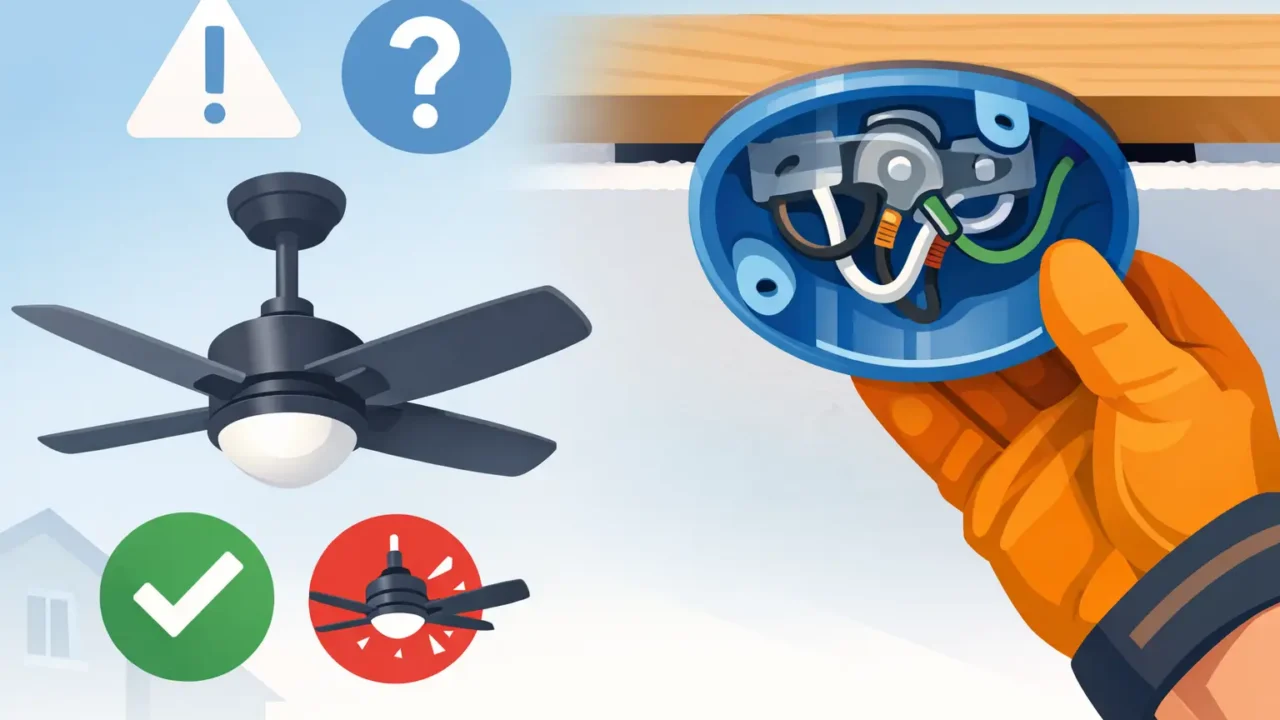
A ceiling fan may look like a simple replacement for an overhead light, but the support behind the ceiling matters far more than the fixture you can see. Can an existing box support fan weight and movement safely? Sometimes, but a standard light-fixture box should never be assumed to be ready for a fan.
Ceiling fans create two kinds of force: their actual hanging weight and the repeated movement created while the blades are turning. In a Dallas-Fort Worth home, especially one with older electrical work, a box that held a lightweight light fixture for years may not be designed or secured to handle those forces. Checking the box before installation can prevent a loose fan, ceiling damage, or an unsafe connection.
What Makes a Ceiling Box Suitable for a Fan?
A fan-rated ceiling box is specifically listed and installed to support a ceiling fan. The box itself is only part of the system. It also needs to be fastened to framing or supported by an approved brace that spans between ceiling joists.
Many fan-rated boxes are marked with wording such as “For Ceiling Fan Support” and may show a weight rating. Some are rated for fans up to 35 pounds, while others are rated for heavier fixtures. The fan manufacturer’s instructions still control. A box rating does not make every fan appropriate for every installation.
A regular light box can be plastic, metal, round, octagonal, or rectangular. Material and shape alone do not tell you whether it is fan-rated. A metal box is not automatically stronger than a plastic one, and a box that feels solid from below may still be attached in a way that is not intended for a moving fixture.
Can an Existing Box Support a Fan? How to Tell
The most reliable answer comes from inspecting the box and its mounting, not from guessing based on the existing light. After power has been turned off at the breaker and verified, the existing fixture must be removed to see the box, labeling, screws, and support arrangement.
Look for a clear fan-support marking
The best sign is a visible manufacturer label stating that the box is approved for ceiling fan support. If the label is readable and the listed weight capacity meets the fan manufacturer’s requirements, that is encouraging. It is still worth checking that the box is in good condition and firmly mounted.
If there is no label, the box should not be treated as fan-rated just because it is metal or has held a chandelier-style light before. The prior fixture may have been too light to reveal a problem, or it may have been installed improperly.
Check how the box is secured
A suitable box is commonly attached directly to a ceiling joist or to a fan-rated brace. A brace is a metal support installed between joists, with the electrical box secured to it. This arrangement spreads the load into the framing rather than placing it on drywall or a light-duty bar.
Warning signs include a box attached only to drywall, a loose box that moves when touched, damaged mounting ears, stripped screw holes, corrosion, cracks, or an improvised support method. Any of these conditions call for correction before a fan goes up.
Consider the fan’s weight and design
A compact fan without a light kit places different demands on the box than a larger fan with a light, remote receiver, and long downrod. Downrod-mounted fans also create more leverage because the fan hangs farther below the ceiling.
The fan instructions should state the required support method and maximum weight considerations. A properly rated box and brace may be needed even when the fan seems relatively light. Safe installation depends on the entire assembly, including the mounting bracket, fasteners, and ceiling structure.
Why a Standard Light Box May Not Be Enough
Light fixtures typically hang in place. A ceiling fan hangs, spins, starts, stops, and can develop vibration over time. That motion gradually works on the mounting points in a way a stationary fixture does not.
Standard light boxes are often intended for a limited fixture load and may be fastened with hardware that is not rated for fan movement. Installing a fan on one can cause the box to loosen, the ceiling drywall to crack, or the fan to wobble. A wobble is not always caused by the box, but a secure, properly supported box must be confirmed before troubleshooting blade balance or other fan issues.
There is also an electrical safety issue. If a box shifts or pulls loose, wire connections can become stressed. The goal is not simply to get the fan mounted. It is to make sure the fan, bracket, box, and wiring are all secure and properly enclosed.
When the Existing Box Should Be Replaced
Replacement is usually the right choice when the box is not marked for fan support, moves in the ceiling, shows visible damage, or is mounted in a way that cannot be verified. It may also be necessary when the new fan exceeds the box’s stated capacity or uses a mounting arrangement the existing setup cannot accommodate.
Replacing the box is not always as disruptive as homeowners expect. In some cases, a fan-rated retrofit brace can be installed through the existing ceiling opening. In others, access from above may be needed, depending on joist direction, ceiling construction, insulation, and the condition of the wiring.
This is one reason fan installation is more than connecting a few wires. The work may be straightforward when the existing box is clearly fan-rated and sound. When it is not, the right next step is to address the support system before installing the new fixture.
A Few Details Worth Checking Before Booking Installation
Having the fan on site helps make the appointment more efficient. Keep the fan box, mounting hardware, instructions, and remote components together. If you know the ceiling height and whether the fan will replace an existing light, share that information when requesting service.
It is also helpful to mention anything unusual: a very high ceiling, a sloped ceiling, an oversized fan, no existing overhead fixture, visible ceiling damage, or a box that seems loose. Clear details set the right expectations before the work begins and help avoid surprises on installation day.
For homeowners who already have a suitable fan and an existing ceiling location, Direct Home Pros can help with professional ceiling fan installation. The work area should be treated carefully, and the completed fan should be tested before the job is wrapped up. If the existing box is not appropriate for the fan, that should be identified clearly rather than covered up with a quick fix.
Do Not Rely on These Common Assumptions
A few shortcuts cause unnecessary risk. Do not assume that a metal box is fan-rated, that a prior light fixture proves the support is adequate, or that a fan mounting bracket can compensate for a weak box. The bracket attaches to the box and support behind it, so it cannot improve an unsuitable foundation.
Likewise, do not judge the setup by the fan’s weight alone. Movement matters. A fan that operates quietly and steadily depends on correct support, proper assembly, and blades that are balanced according to the manufacturer’s instructions.
If you cannot confirm that the existing box is fan-rated and securely mounted, treat it as an open question rather than a yes. A few minutes spent verifying the support can protect your ceiling, your new fan, and the people beneath it for years to come.