A ceiling fan can be the right size and style for a room yet still look awkward or move very little air if it hangs at the wrong height. To choose ceiling fan downrod length correctly, start with the ceiling height, then account for blade clearance, room layout, and the fan manufacturer’s requirements. A little measuring before installation helps the fan perform better and keeps it safely out of the way.
Why Downrod Length Matters
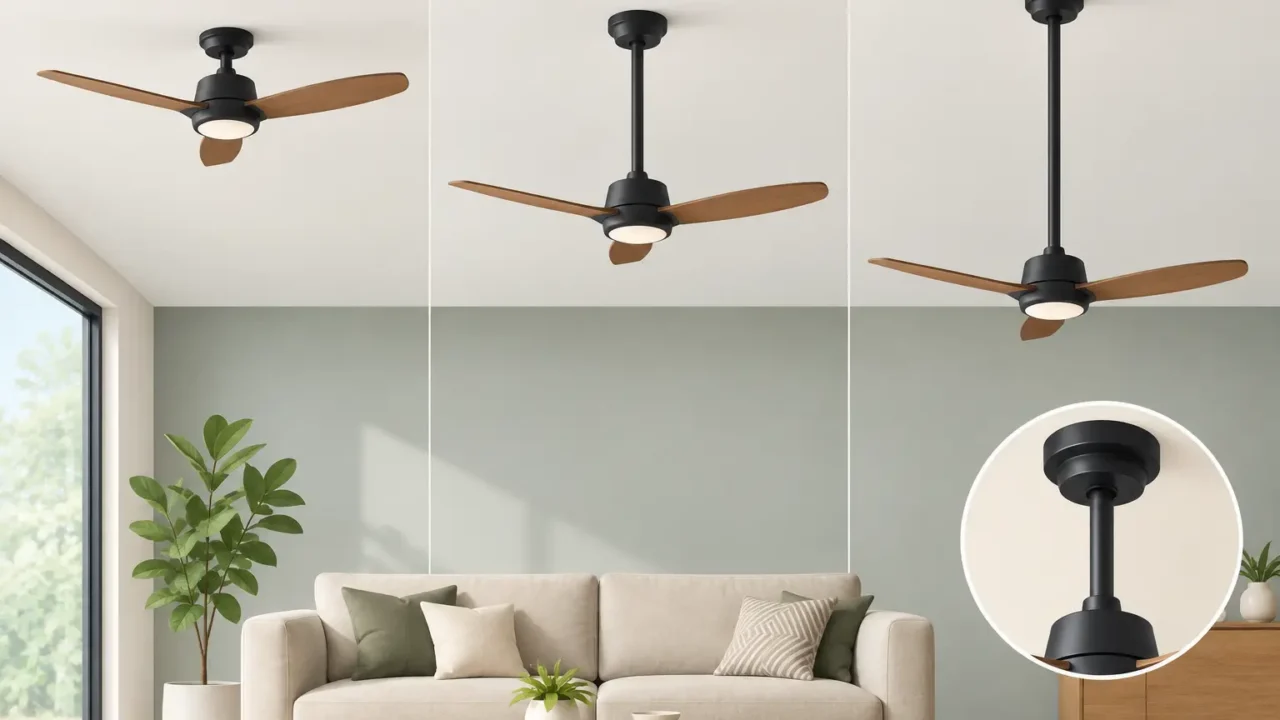
The downrod is the metal pipe that connects a ceiling fan’s motor housing to the mounting bracket at the ceiling. It sets the fan’s hanging height. Choosing the wrong length can put the blades too close to the ceiling, where airflow is restricted, or too low over a bed, dining table, walkway, or other part of the room.
For most rooms, fan blades perform best about 8 to 9 feet above the floor. That height gives the blades enough open space to circulate air effectively while maintaining comfortable clearance below. Building and safety guidance generally calls for fan blades to be at least 7 feet above the floor, but aiming higher when the room allows is usually the better choice.
The goal is not simply to use the longest downrod available. It is to place the fan at a useful, safe height that fits the room. A great-room fan on a 16-foot ceiling may need a long downrod, while the same fan on an 8-foot ceiling may need a low-profile mounting option instead.
Measure the Ceiling Height First
Measure from the finished floor to the finished ceiling at the fan’s planned location. Do not estimate based on another room. Ceiling heights can change at tray ceilings, vaulted areas, additions, and rooms with flooring that was replaced over time.
Next, decide where you want the blades to sit. In many Dallas-Fort Worth homes, an 8- to 9-foot blade height works well for living rooms, bedrooms, offices, and open-concept spaces. Subtract that target height from the ceiling height to estimate the total distance the fan needs to hang down.
For example, a room with a 10-foot ceiling and a target blade height of 8.5 feet needs the blades to hang about 18 inches below the ceiling. That does not automatically mean an 18-inch downrod. The motor housing, mounting hardware, canopy, and blade arm design all contribute to the overall drop.
This is the detail homeowners often miss: downrod length and total fan drop are not the same measurement. Review the fan’s installation guide or specification sheet for its listed blade-to-ceiling distance with each compatible downrod length.
A Practical Starting Point by Ceiling Height
Every fan model is different, but these ranges are useful starting points for a standard installation:
- An 8-foot ceiling often calls for a flush-mount or low-profile fan, rather than a downrod.
- A 9-foot ceiling commonly works with a short downrod, often around 4 to 6 inches.
- A 10-foot ceiling often needs a downrod around 12 inches.
- An 11-foot ceiling may need an 18-inch downrod.
- A 12-foot ceiling often uses a 24-inch downrod.
- Ceilings higher than 12 feet may require 36-inch, 48-inch, or longer options.
Use these as planning ranges, not a substitute for the manufacturer’s dimensions. Some fans have taller motor housings than others, and decorative models can hang farther below the downrod connection.
Consider the Room’s Layout, Not Just the Ceiling
A fan’s location changes the right answer. In a bedroom, a fan centered over the bed may be able to hang slightly lower than one installed over an open walking area. Over a dining table, a fan can be positioned higher than a light fixture because people do not need to see underneath it in the same way, but the blades still need safe clearance from standing occupants.
In a living room, look at where people walk, where doors swing, and whether tall furniture sits below the fan. A fan that is technically at the minimum 7-foot clearance can still feel uncomfortably low in a frequently used path.
Also consider how the fan will look from nearby rooms. An overly long downrod can make a fan feel disconnected from the ceiling in a modest-sized room. On the other hand, a fan mounted too high in a vaulted living room can look undersized and fail to deliver the airflow you expected.
How to Choose Ceiling Fan Downrod Length for Vaulted Ceilings
Vaulted and sloped ceilings require more than a longer rod. First, confirm that the fan is rated for angled mounting and check its maximum approved ceiling slope. Some models work with moderate slopes using the included hardware. Others need a separate angled-ceiling adapter, and some are not suitable for sloped installation at all.
The downrod must be long enough for the blades to clear the angled ceiling as they rotate. This becomes especially important when the fan is mounted near the higher side of the slope or when it has long blades. Clearance requirements vary by manufacturer, so follow the instructions for that specific model rather than relying on a general rule.
On a tall vaulted ceiling, the fan should usually hang lower than it would on a flat ceiling. Otherwise, warm air collects near the ceiling while the occupied part of the room gets limited benefit. The right downrod can bring the fan into the room’s usable air space without putting it too low.
A properly installed fan on a sloped ceiling also needs the right mounting box, bracket, and support. The electrical box must be rated to support a ceiling fan. A standard light-fixture box is not automatically sufficient.
Do Not Assume a Longer Downrod Is Always Better
A longer downrod can improve air movement in a tall room, but it introduces trade-offs. Very long downrods can make a fan more noticeable from adjoining spaces, may require a matching finish, and can increase the chance of wobble if the fan is not installed and balanced correctly.
The downrod itself should be compatible with the fan. Diameter, threading, mounting holes, locking pins, and safety cables vary. Using a generic rod that does not match the manufacturer’s approved specifications can affect stability and may void the fan warranty.
If the room is especially tall, consider whether the fan’s size and airflow rating are also appropriate. Lowering a small fan with a longer rod will not necessarily provide the coverage a large open room needs. Fan blade span, motor performance, and placement all matter alongside hanging height.
Check for Clearance Around the Blades
Floor clearance is only one part of the measurement. Most manufacturers recommend keeping the blade tips at least 18 inches from walls, cabinets, beams, and other vertical surfaces. More space is often better for airflow and appearance.
Look for obstacles above the fan as well. Exposed beams, ceiling treatments, sprinkler heads, pendant lights, and attic access panels can interfere with installation or future maintenance. If the fan includes a light kit, make sure there is enough room for the fixture and bulbs below the motor housing.
For outdoor-covered areas, use a fan rated for the location. A damp-rated fan is designed for covered porches and patios where it may be exposed to humidity and moisture, while a wet-rated fan is intended for more direct weather exposure. Downrod length still matters outdoors, especially under tall patio covers where the fan needs to move air down to where people sit.
Before You Buy the Fan or Downrod
Confirm the ceiling height and measure the planned fan location. Then review the fan’s specification sheet for the standard downrod size, the overall hanging height, approved replacement downrods, and angled-ceiling limitations. If the fan will be controlled by a wall switch, remote, or smart-home system, verify compatibility before installation as well.
It is also wise to confirm that the existing ceiling box is fan-rated and securely supported. A ceiling fan is heavier and creates more movement than a typical light fixture. Proper mounting, secure wiring connections, blade balancing, and final testing all matter just as much as selecting the correct downrod.
For homeowners in Hurst, Euless, Bedford, Grapevine, Fort Worth, and nearby DFW communities, Direct Home Pros can install customer-supplied ceiling fans with clear expectations, careful worksite cleanup, and testing once the work is complete. When you have the ceiling measurement, fan model, and preferred placement ready, the installation process is much more straightforward.
The right downrod is the one that gives your fan enough room to work, enough clearance to be safe, and a height that feels natural in the room every day.